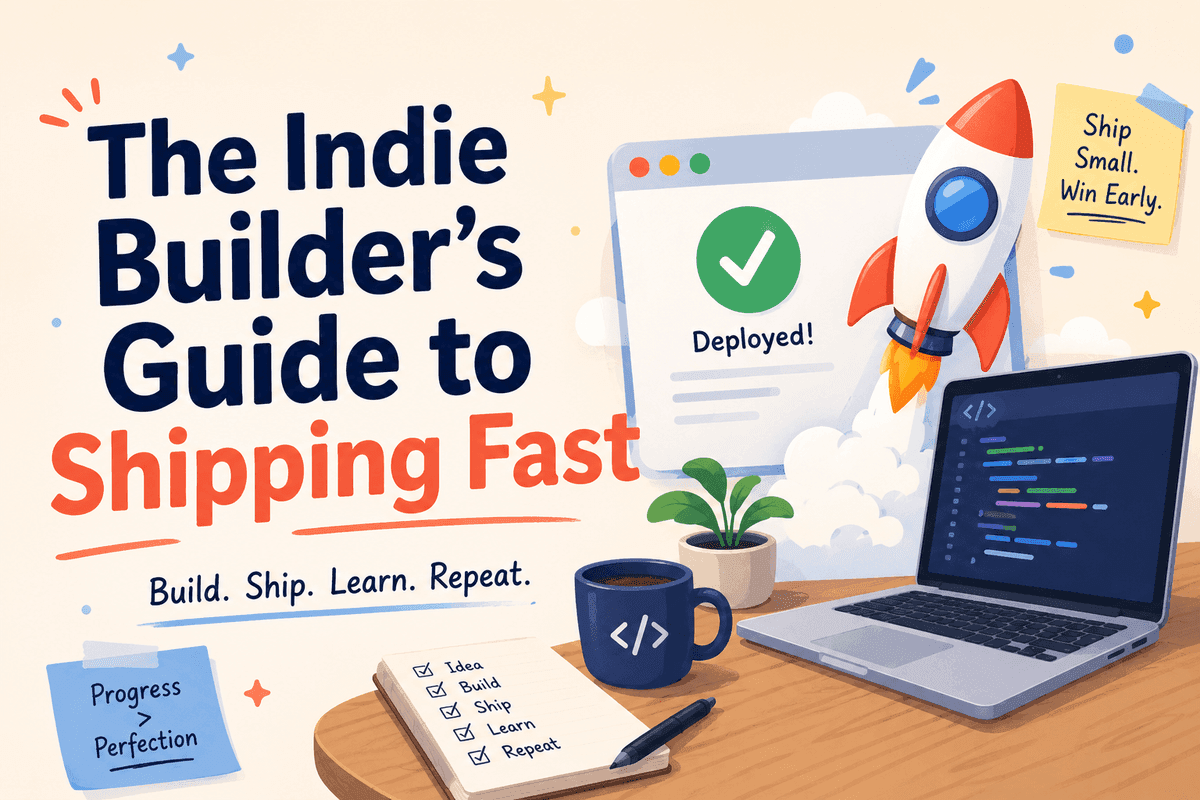
Most indie developers don't fail because they move too slowly. They fail because they spend months polishing things nobody actually needed.
I used to think shipping fast meant writing messy code. I thought it meant skipping architecture entirely. "Just get it working and figure it out later."
That strategy works brilliantly. For exactly two weeks.
After that, your velocity completely collapses under its own weight. Every new feature breaks two old ones. You spend 80% of your time fixing state bugs instead of building value. You start dreading your own codebase, which, when you're building solo, is the fastest way to quietly stop building at all.
So no, this isn't an argument for moving recklessly. It's the opposite. It's about understanding what speed actually is, because most people are optimizing for the wrong thing entirely.
#Real Speed Is About Friction, Not Typing Speed
Real speed doesn't come from typing faster, using a fancier keyboard, or memorizing more shortcuts. It comes from reducing decision friction, the dozens of tiny choices that stand between "I have an idea" and "it's live."
The best builders I know optimize for momentum. Not perfection.
They avoid unnecessary abstractions like the plague. They keep their tech stack ridiculously boring, not because boring is virtuous in itself, but because boring means fewer surprises, more Stack Overflow answers, and zero hours lost debugging a library nobody else uses. They make decisions that are intentionally easy to undo later, because the goal isn't to be right on the first try. It's to be wrong cheaply and often, until you're right.
They understand something crucial: every single layer of complexity you add today becomes future maintenance debt tomorrow. And when you're building alone, with no team to absorb that debt, maintenance debt doesn't just slow you down, it will literally kill your product. There's no one else to pick up the slack while you untangle a state management system you were clever enough to build but not disciplined enough to maintain.
#Users Do Not Care About Your System
This was one of the biggest mindset shifts for me. Users do not care how sophisticated your system is.
They do not care if you used Next.js or raw HTML. They do not care if you implemented a custom event bus, or whether your backend is serverless, edge-rendered, or a single monolithic Node script running on a $5 VPS. They will never see your architecture diagram, and if they did, they wouldn't care about that either.
They care about one thing: does this solve my problem, quickly, and reliably?
That's it. That's the whole bar. And once you actually internalize that, it changes how you build everything.
Instead of spending three days designing the perfect database schema, you ship the feature with reasonable defaults and observe how people actually use it first. Reality will tell you things your whiteboard never could, which fields actually matter, which edge cases actually occur, which "obvious" feature nobody touches.
Instead of building a massive, comprehensive design system upfront, you create reusable patterns gradually. You extract components only when repetition appears naturally, not because a style guide said you should. Premature abstraction is just procrastination wearing a nicer outfit.
#Optimize for Iteration Speed, Not Impressiveness
Good indie builders treat codebases like living systems. Not portfolio pieces meant to impress other engineers who will, statistically, never read the code.
They ruthlessly optimize for iteration speed: simple architecture, fewer third-party dependencies, minimal deployment friction, fast local development environments. Every one of these is a small tax you pay every single day you work on the project, and small daily taxes compound into enormous yearly losses.
Because the real bottleneck in product development is rarely the coding itself. It's the hesitation. It's the friction between having an idea at 11pm and seeing it live on a screen before that feeling fades. The builders who win aren't the ones with the cleverest code, they're the ones who shortened that gap until it became a reflex.
A few patterns I've come to trust, almost as defaults now:
One stack, used everywhere. Not because it's the best stack in the abstract, but because switching costs are real and you've already paid them once.
Boring infra over clever infra. Managed services over self-hosted clusters. A platform that handles scaling for you over a system you'd have to babysit.
Fewer dependencies, chosen deliberately. Every package you add is a future breaking change waiting to happen on someone else's schedule, not yours.
Ship the ugly version first. A working feature with default styling beats a beautifully designed feature that's still in your head.
Delete before you abstract. If you're not sure whether to generalize something, wait. You can always abstract later; un-abstracting bad guesses is far far more painful.
None of this is about cutting corners on quality where it actually matters, it's about being deliberate about where your effort goes, instead of spreading it evenly across things that don't equally matter.
#Learn in Public
The internet disproportionately rewards builders who learn quickly, in public. And learning requires shipping before you feel fully ready, putting something imperfect in front of real people instead of polishing it alone in the dark for another month.
This is uncomfortable, by design. Nobody enjoys shipping something they know has rough edges. But the alternative, waiting until it's "ready", is how good ideas quietly die in private repos that never see a deploy button.
Ironically, moving fast sustainably requires immense discipline. Clean variable naming. Consistent UI patterns. Thoughtful, even if minimal, UX decisions. These things actually matter more when you're iterating aggressively, not less, because otherwise, every new feature increases the chaos instead of the momentum. Speed without discipline isn't speed. It's just a faster way to arrive at a mess.
The discipline isn't a brake on speed. It's what makes speed survivable past week two.
#The Real Goal: Shorten the Feedback Loop
Shipping fast is not about being reckless. It's about intentionally reducing everything that slows down the feedback loop, the loop between you and reality. Between the idea in your head and the evidence of whether it actually mattered to anyone.
Every hour spent on an abstraction nobody asked for, a pixel nobody will notice, or an architecture decision made for a scale you don't have yet, is an hour stolen from that loop. And that loop, building, shipping, watching what real people actually do, adjusting, is where real progress actually happens.
Not in the planning. Not in the polish. In the loop.
So the next time you're tempted to spend another week "doing it properly" before anyone's even seen it, ask yourself honestly whether you're protecting quality, or just avoiding the discomfort of finding out if it works.
Ship it. Watch what happens. Then decide what's actually worth fixing.