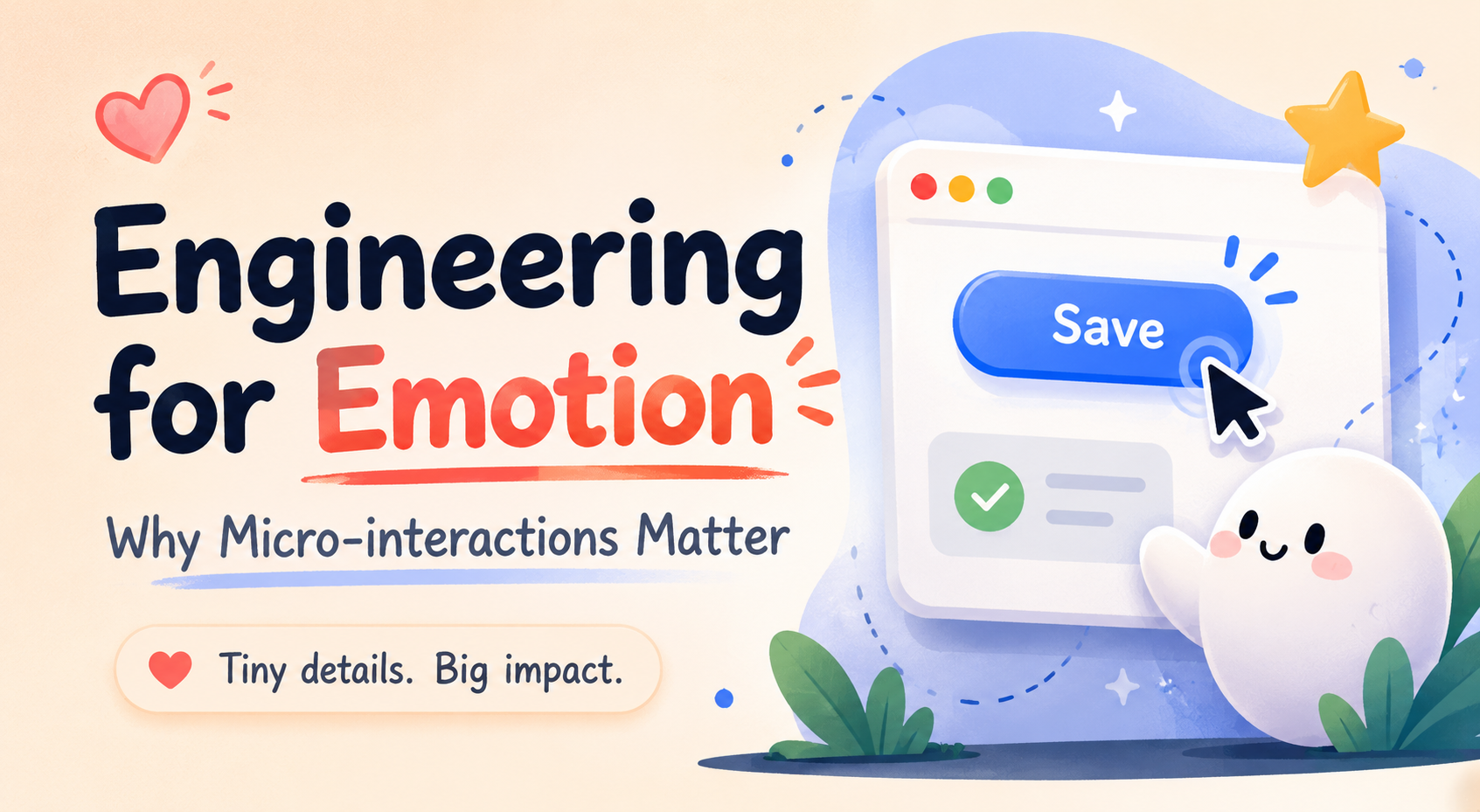
Most developers think performance is about speed. Users think performance is about feeling.
You can have the fastest APIs in the world. You can optimize your database queries down to the millisecond. You can boast about your perfect 100 Lighthouse score. And still build a product that feels incredibly frustrating to use.
I learned this the hard way. A few years ago, I shipped a dashboard for a client. Technically, it was flawless. The metrics looked great. The initial load time was under a second. But when real people started using it? It was emotionally exhausting.
Buttons lacked feedback. When you clicked "Save", nothing happened for 300 milliseconds. Then the page just jumped. Loading states shifted the entire layout down by 40 pixels. Modals appeared abruptly, with no transition. Forms threw errors instantly before you even finished typing.
These seem like tiny details. But together, they made the product feel unreliable. Cheap. Broken.
Trust Is Built In Milliseconds
That’s the thing most engineers miss. Micro-interactions are not decoration. They are trust signals.
When a user clicks a button and it depresses slightly. When a hover state fades in smoothly over 150ms. When a loading spinner pulses gently while work happens in the background.
A subtle button animation tells the user: “I hear you. Your action was received.”
A smooth layout transition tells the user: “Don't panic. The system is stable.”
A preserved scroll position when navigating back tells the user: “You’re still in control here.”
Without these signals, your interface feels cold. Unpredictable. Like a machine that might break at any moment. Even when the backend is functioning perfectly.
Software Through Movement
The best product teams understand this deeply. Users experience software through movement. Not through static Figma screenshots.
They experience it through clicks. Through delays. Through transitions. Through retries and failures.
Good UX is almost never about flashy animations. It’s not about WebGL backgrounds or crazy scroll jacking. It’s about continuity.
Continuity of thought. Continuity of attention. Continuity between what the user intends to do, and how the system responds.
The Real Challenge
Ironically, the hardest part of frontend engineering today isn’t building interfaces. We have Tailwind for that. We have component libraries for that.
The hardest part is making complex systems feel calm. Hiding the chaos of network latency. Smoothing over the rough edges of asynchronous data fetching. Making a distributed system feel like a single, solid object in the user's hand.
And that’s what separates software that merely works. From software people genuinely fall in love with.